Fear Not!365 Days a Year
Learn How To Overcome Fear



Aphilosopher once gave this axiom to arrive at the fact that he really did exist: "I think; therefore, I am." He could not say: "I'm just imagining that I exist" -- for as soon as he included the "I" in his statement, he was admitting that a self existed.
A person's selfhood is one of the most profound things in the universe. It should humble us and overwhelm us to think that we are individuals, separate from others. We are islands in many ways. No one can feel your exact feelings or think your exact thoughts. They are solely yours. They are inextricably part of you and you alone.
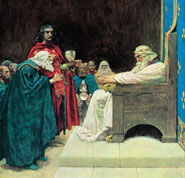
Within this part of our humanity ("self") lies that which is of utmost importance to God: our self-will. The will is that part of us which is truly ours, and truly us. Imagine our lives are like throne rooms, and our will sits on the throne over our own little universe. When outside information comes to the attention of our will, we do with it what we please. That is, we have a choice to make. And because it is our universe and our will is on the throne, the choice is final.
So in comes some information from another part of our universe, while our will is seated on the throne. "Dear king," we hear, "it has come to my attention that you will suffer greatly if you eat that third piece of pie." This is our conscience speaking, and we can either ignore the information or listen to it and heed it. "Away from me, you silly fool," says the will, "I'll walk around the block after supper and be just fine."
This is an important concept to understand, for it has everything to do with how we regard God. At some point in our lives, it's likely that our conscience brings us some "outside" information concerning God. It might go something like this:
"Dear king, it has come to my attention (and I certainly wanted to alert you of it) that someone called God is seeking entrance into your universe. He says that he has free reign to go anywhere he likes, but that he will not come into your universe unless expressly invited.
"He also says that if he comes in, he will probably have great influence over the decisions you make on your throne. I really am sorry, but that's what he says. But, says he, if you do this, your universe will become a better place. He says he is loving, and only wants what's best for you -- which is Him.
"He gave me the impression that he, unlike yourself, if you don't mind me saying so, is some sort of perfect King. He says you can trust him, better than you can trust yourself. So, what say you? Would you like to give him permission to enter?" (James 4:1-7)
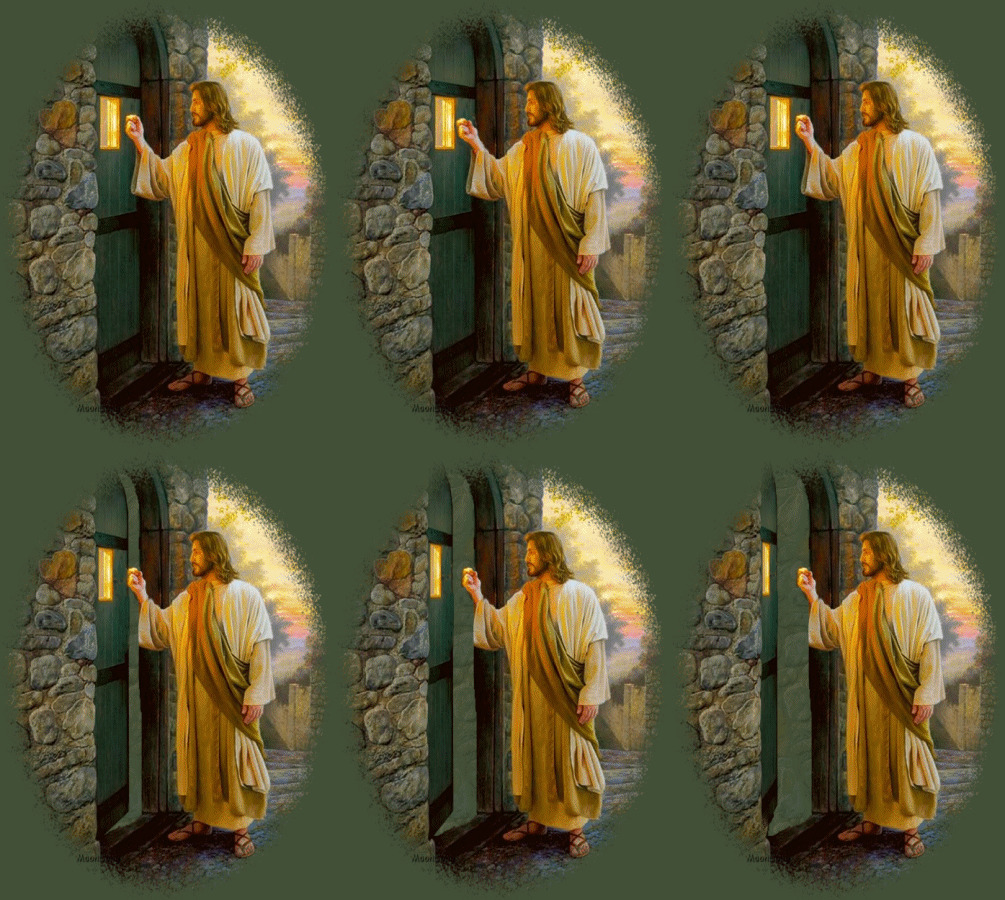
Haven't we all experienced something like that? God lets us make the decision. That is the great dignity with which he treats us. He does not barrel into our universe. He does not overthrow our monarch. Instead, he asks to come in. In his own words, Jesus said, "Behold, I stand at the door and knock. If anyone hears my voice and opens the door, I will come in."
John states it well in the Bible, "We have come to know and to believe the love that God has for us. God is love, and whoever abides in love abides in God, and God abides in him. By this is love perfected with us, so that we may have confidence for the day of judgment." (1John 4:16,17)
Jesus' prayer right before his death: "Righteous Father, though the world does not know you, I know you, and they [Jesus' followers] know that you have sent me. I have made you known to them, and will continue to make you known in order that the love you have for me may be in them and that I myself may be in them." (John 17:25,26)
Jesus is standing at a door and knocking. But the illustration of Jesus' offering salvation to individuals is not what is going on here. In Revelation 3:20, Jesus is not pleading with an individual to be saved; He's seeking admittance to a church! It's alarming to think of Jesus standing outside of a church and knocking, but that is what John is writing here. The Laodicean church had shut the door on the Head of the church; they were smug in their prosperity, but Jesus was left standing in the cold. He was an outsider to the hearts of the entire congregation.
To the congregation at Laodicea, Jesus issued this scathing criticism: "I know your deeds, that you are neither cold nor hot. I wish you were either one or the other! So, because you are lukewarm-neither hot nor cold-I am about to spit you out of my mouth. You say, 'I am rich; I have acquired wealth and do not need a thing.' But you do not realize that you are wretched, pitiful, poor, blind and naked'" (Revelation 3:15-17).
In their proud, self-satisfied, and spiritually blind state, the church of Laodicea was useless in God's kingdom. Using figurative language, Jesus issued His command, beckoning the members of the church to exchange their counterfeit righteousness for genuine righteousness (Revelation 3:18). He called the church to be zealous and repent (verse 19).
When Jesus said, "I stand at the door and knock," He was inviting the members of the Laodicean church to recognize their miserable spiritual condition and receive His authentic gift of salvation. Like the apostle Paul, the Laodiceans needed to realize their absolute dependence on Christ: "What is more, I consider everything a loss because of the surpassing worth of knowing Christ Jesus my Lord, for whose sake I have lost all things. I consider them garbage, that I may gain Christ and be found in him, not having a righteousness of my own that comes from the law, but that which is through faith in Christ-the righteousness that comes from God on the basis of faith" (Philippians 3:8-9).
The Lord's plea is personal. He does speak to individuals using singular words like anyone, his, him, and he. He is inviting everyone in the church to experience intimate fellowship with Him. And even though His desire was for the whole church to respond and open the door to Him, ultimately it was up to the individual to decide.
Jesus knows that not everyone will answer His invitation and open the door to a relationship with Him. Many, like those living in Laodicea, will choose to reject His call. Lukewarm, and with hardened hearts, they will remain blind to the fact that they have accepted a false righteousness (Hebrews 3:7-8). To these Jesus will say, "I never knew you, depart from me" (Matthew 7:21-23). Sadly, they will not enter the kingdom of heaven.
When you see this illustration of Jesus knocking at the door or sitting on the throne remember, it is not just a personal invitation. It is a collective invitation. Are you involved in a church, a group, or some sort of cause? Are they putting Christ on the throne. Are they worshiping the one true God in love and peace. If not, then you need to find the strength in your soul to open the door of your heart and let him in personally. Then to somehow bring others to do the same. If you cannot, allow yourself the privilege to seek another church, group, or start your own by putting God first. JESUS wants to come in. Jesus longs for you to let him in and be the center of your life, your universe, the reason that you take your next breath. Relax, just breath.
For info on having a relationship with God, see Knowing God Personally.

GotQuestions.org is a ministry of dedicated and trained servants who have a desire to assist others in their understanding of God, Scripture, salvation, and other spiritual topics. We are Christian, Protestant, evangelical, theologically conservative, and non-denominational. We view ourselves as a para-church ministry, coming alongside the church to help people find answers to their spiritually related questions.
We will do our best to prayerfully and thoroughly research your question and answer it in a biblically based manner. It is not our purpose to make you agree with us, but rather to point you to what the Bible says concerning your question. You can be assured that your question will be answered by a trained and dedicated Christian who loves the Lord and desires to assist you in your walk with Him. Our writing staff includes pastors, youth pastors, missionaries, biblical counselors, Bible/Christian college students, seminary students, and lay students of God's Word.


